Tag: japan

  • Japan Visa, Residence Card and City Office Basics

    Japan Visa, Residence Card and City Office Basics

    For many foreigners, the most confusing part of living in Japan is not the train system, the language, or even the culture.

    It is the paperwork.

    Visa. Status of residence. Residence card. City office. Address registration. My Number. Health insurance. Pension. Moving notification. Renewal deadline.

    These words may sound technical, but they are part of daily life in Japan. Whether you are an international student, worker, dependent, spouse, researcher, business professional, or new resident, understanding these basics can protect your legal status, save you from trouble, and make your life much easier.

    Japan is a country where systems matter. If your documents are correct, your address is registered, your insurance is active, and your deadlines are managed, life becomes smoother. But if you ignore small procedures, they can become serious problems later.

    This guide explains the basic things every foreign resident should know after coming to Japan.

    Important Note Before You Read

    This article is for general guidance only. Immigration, city office, insurance, pension and tax rules can change, and details may differ depending on your nationality, residence status, municipality, employer, school, family situation and personal case.

    For official decisions, always confirm with the Immigration Services Agency of Japan, your city or ward office, your school, your employer, or a qualified professional.

    AIC Japan’s goal is to make the basic system easier to understand so you know what to check and where to start.

    1. Visa and Status of Residence Are Not Exactly the Same

      Many people use the word “visa” for everything.

      For example, they say:

      “My visa will expire soon.”
      “I want to change my visa.”
      “My student visa allows part-time work.”

      In daily conversation, this is common. But technically, Japan separates “visa” and “status of residence.”

      A visa is usually connected to entering Japan from overseas. It is generally issued by a Japanese embassy or consulate before you travel to Japan. After you arrive and receive landing permission, your legal activities in Japan are controlled by your status of residence.

      This difference is important.

      Once you are living in Japan, many important procedures are not really “visa procedures.” They are residence status procedures, such as:

      • Extension of period of stay
      • Change of status of residence
      • Permission for part-time work
      • Re-entry permission
      • Address registration
      • Residence card updates
      • Reporting certain changes

      So, after arrival, do not only think, “ work
      • Re-entry permission
      • Address registration
      • Residence card updates
      • Reporting certain changes

      So, after arrival, do not only think, “Do I have a visa?”

      Think, “Is my status of residence correct for what I am doing in Japan?”

      2. Certificate of Eligibility: The First Big Step for Many Long-Term Residents

        Many students, workers, dependents and long-term residents first hear about the Certificate of Eligibility, commonly called COE.

        A COE is usually part of the process before entering Japan for medium- or long-term stay. In simple words, it helps show that your planned activity in Japan matches a valid residence status.

        For example:

        • A student plans to study at a Japanese school or university
        • A worker plans to work for a Japanese company
        • A dependent plans to join a family member in Japan
        • A researcher plans to conduct research in Japan

        After the COE is issued, the person usually applies for a visa at a Japanese embassy or consulate overseas. Then, after entering Japan, the person receives landing permission and residence status.

        For newcomers, the key point is this:

        COE, visa, landing permission, residence status and residence card are connected, but they are not the same thing.

        3. Your Residence Card Is One of the Most Important Documents in Japan

          For most medium- to long-term foreign residents, the residence card is one of the most important documents in Japan.

          It is not just an ID card. It is proof of your legal residence status in Japan.

          Your residence card usually shows:

          • Name
          • Date of birth
          • Nationality or region
          • Address
          • Status of residence
          • Period of stay
          • Work restriction information
          • Permission for extra-status activities, if applicable
          • Card expiration information

          Foreign residents aged 16 or older are generally required to carry their residence card.

          This means you should not leave your residence card at home casually.

          You may need it when:

          • Opening a bank account
          • Signing a phone contract
          • Applying for housing
          • Registering your address
          • Visiting immigration
          • Starting part-time or full-time work
          • Renewing your residence period
          • Verifying your identity
          • Dealing with police or administrative procedures

          Always check the information printed on your residence card. A small mistake can create problems later.

          4. Address Registration Must Be Done at the City or Ward Office

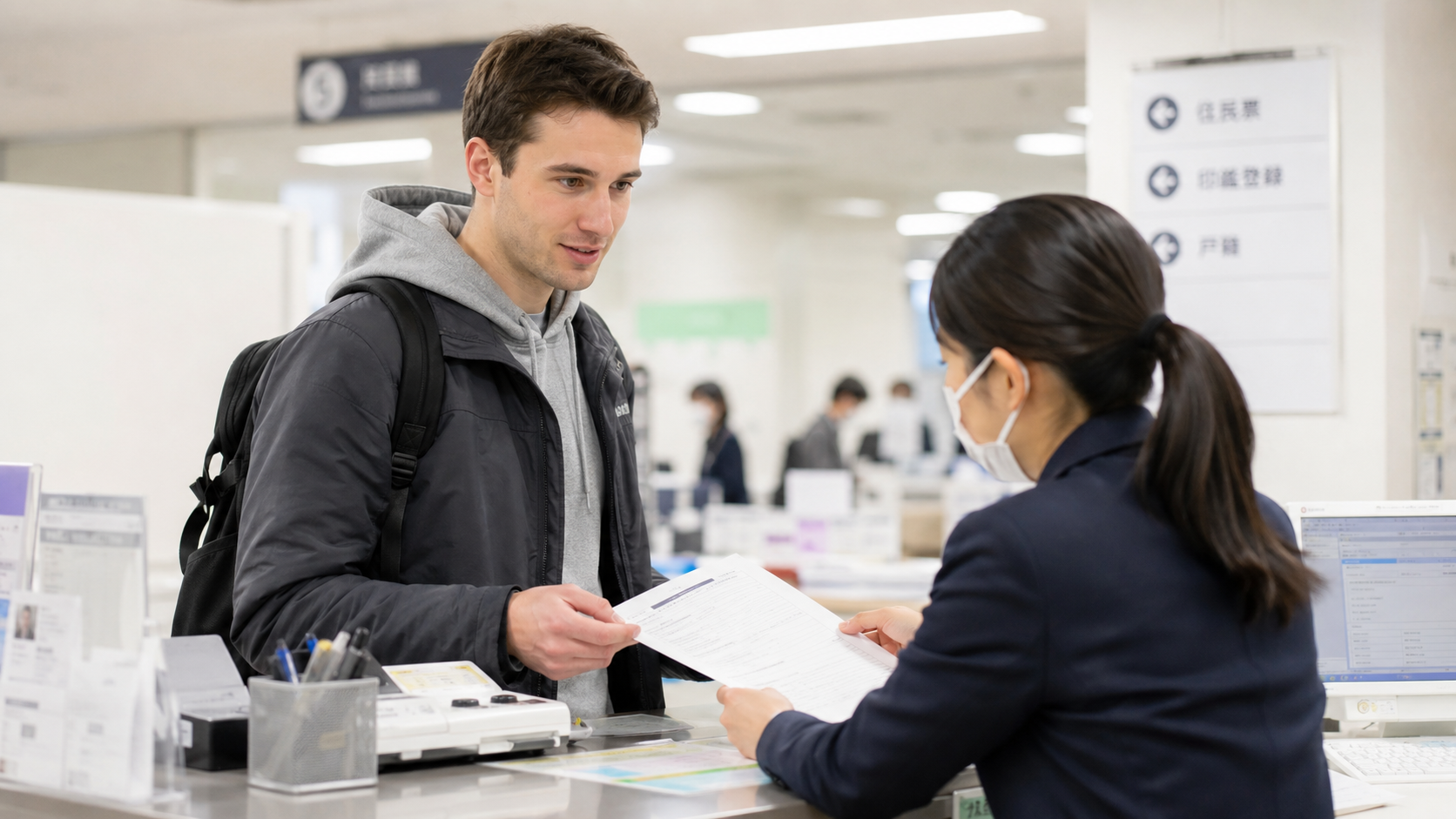
            After arriving in Japan and deciding your place of residence, you generally need to register your address at your local municipal office.

            This may be called:

            • City office
            • Ward office
            • Town office
            • Village office
            • Municipal office

            After you settle at your address, you usually need to submit a moving-in notification at the municipal office within the required period.

            This is one of the first procedures newcomers should complete.

            Do not delay it.

            Without address registration, you may face problems with:

            • Health insurance enrollment
            • Pension procedures
            • My Number notice
            • Bank account opening
            • Phone contract
            • School or company paperwork
            • Official mail
            • Visa or residence procedures later

            A simple first rule for newcomers:

            After you move into your address, go to the city or ward office as soon as possible.

            5. What to Bring to the City Office

              The required documents may differ depending on your city, ward and situation. But in many cases, newcomers should prepare:

              • Residence card
              • Passport
              • Address information
              • Apartment or dormitory information
              • School or employer documents, if available
              • Family relationship documents, if moving with family
              • Marriage certificate or birth certificate, if applicable
              • Japanese translation of family documents, if required
              • My Number card, if you already have one
              • Previous moving-out certificate, if moving from another municipality

              Because requirements can differ, check your local city office website or ask the information counter.

              6. City Office Procedures Are Not Only Address Registration

                Many newcomers think the city office is only for address registration.

                Actually, the city office is where many important daily-life procedures begin.

                Depending on your situation, you may need to handle:

                • Moving-in notification
                • Moving-out notification
                • Address change
                • National Health Insurance
                • National Pension
                • My Number procedures
                • Residence certificate
                • Seal registration, if needed
                • Child allowance, if applicable
                • School enrollment for children
                • Tax-related notices
                • Garbage collection information
                • Disaster prevention information

                The city office is one of the most important places for foreign residents in Japan.

                Even if you cannot speak Japanese well, go early and ask. Many city offices have English materials, translation devices, multilingual information pages, or foreign resident support counters.

                7. Moving Within Japan Also Requires Procedures

                  If you move from one address to another in Japan, you usually need to update your address.

                  If you move within the same city, you may need a change-of-address notification.

                  If you move to another city, you usually need to complete procedures at both the old municipality and the new municipality.

                  This matters because your address is connected to many things:

                  • Residence card
                  • Health insurance
                  • Pension
                  • Taxes
                  • My Number
                  • School documents
                  • Employer records
                  • Immigration notices
                  • Bank and phone contracts
                  • Official city mail

                  Never assume that simply moving to a new apartment is enough. You must update the official record.

                  8. My Number Is Connected to Administrative Procedures

                    My Number is Japan’s individual number system.

                    It is used for administrative procedures related to areas such as social security, tax and disaster response.

                    For foreign residents, My Number becomes relevant after resident registration.

                    You may need it for:

                    • Tax procedures
                    • Employment paperwork
                    • Social insurance
                    • Bank-related procedures
                    • Government services
                    • Some online applications
                    • My Number Card application
                    • Health insurance certificate use, depending on system setup

                    Do not share your My Number casually. It is sensitive personal information.

                    Keep your My Number notice, card and related documents safely.

                    9. National Health Insurance Is a Major City Office Procedure

                      Health insurance is one of the most important systems in Japan.

                      If you are employed by a company, you may be enrolled in employee health insurance through your employer. If you are not covered by employee health insurance, you may need to join National Health Insurance through your municipality.

                      This is important for students, dependents, freelancers, job seekers and people between jobs.

                      Do not ignore health insurance procedures or payment notices.

                      Without proper insurance, medical costs can become very expensive. Also, unpaid insurance premiums may create administrative problems later.

                      At the city office, ask:

                      • Do I need to enroll in National Health Insurance?
                      • What is my monthly premium?
                      • How do I pay?
                      • What should I do if I leave Japan?
                      • What should I do if I get company insurance later?
                      • What should I do if my income changes?

                      10. National Pension Also Matters for Foreign Residents

                        Many newcomers are surprised when they receive pension letters.

                        But Japan’s pension system also applies to foreign residents.

                        This does not mean every person pays in the same way.

                        For example:

                        • Company employees may be covered through employee pension
                        • Students may be able to apply for student payment special systems
                        • Low-income residents may be able to apply for exemption or postponement
                        • Some short-term foreign residents may later apply for a lump-sum withdrawal payment after leaving Japan, depending on conditions

                        The key point is simple:

                        Do not ignore pension letters.

                        If you do not understand the letter, bring it to the city office, pension office, school office, employer, or a trusted support center.

                        11. Work Permission Depends on Your Status of Residence

                          Your residence card may show whether you can work or whether there are restrictions.

                          This is very important.

                          Some residence statuses allow work in a specific field. Some do not allow work unless permission is granted. Some allow work with limits. Some dependents and students need permission for part-time work.

                          Do not assume that all foreigners in Japan can work freely.

                          Before accepting any job, check:

                          • Your status of residence
                          • Work restrictions on your residence card
                          • Whether extra permission is needed
                          • Weekly hour limits, if applicable
                          • Whether the job type is allowed
                          • Whether the work could affect future renewal

                          For students and dependents, part-time work can be helpful, but it must be done legally. If your work violates your status conditions, it can affect your future stay in Japan.

                          12. Residence Period and Renewal Deadlines Must Be Managed Carefully

                            Your residence card shows your period of stay.

                            This date is extremely important.

                            Do not wait until the last moment.

                            Before your residence period expires, you may need to apply for extension of period of stay. If your activity changes, you may need to apply for change of status of residence.

                            Common examples:

                            • Student continuing study
                            • Student becoming employee
                            • Worker changing job type
                            • Dependent starting work
                            • Spouse changing family situation
                            • Researcher changing institution
                            • Language school student entering university
                            • University student entering graduate school

                            Immigration procedures take time. Some applications may require documents from your school, employer, guarantor, family member, or municipality.

                            A good habit:

                            Start checking your renewal documents at least two to three months before expiration.

                            13. Families and Dependents Should Be Extra Careful With Documents

                              If you live in Japan with your spouse, children or family members, city office and immigration procedures can become more detailed.

                              You may need:

                              • Marriage certificate
                              • Birth certificate
                              • Family relationship certificate
                              • Japanese translations
                              • Residence cards for each family member
                              • Passports for each family member
                              • School documents for children
                              • Health insurance enrollment for family members
                              • Pension and tax-related procedures
                              • Child allowance or child medical support procedures, if applicable

                              Municipalities may ask for original documents or translated documents depending on the procedure. Requirements differ by city and case.

                              Do not assume that one family member’s procedure automatically covers everyone. Check each person’s residence card, insurance, My Number, and municipal registration.

                              14. Residence Certificate: A Useful City Office Document

                                After you register your address, you may be able to request a residence certificate, called juminhyo.

                                This document may be needed for:

                                • School procedures
                                • Company procedures
                                • Visa or immigration-related documents
                                • Housing contracts
                                • Family procedures
                                • Bank or official applications
                                • Scholarship applications
                                • Child-related procedures

                                A residence certificate is usually issued by your municipality. There may be a small fee.

                                When requesting it, check whether you need:

                                • Individual certificate or household certificate
                                • Nationality shown or hidden
                                • Residence status shown or hidden
                                • My Number shown or hidden
                                • Relationship to household head shown or hidden

                                Do not request unnecessary personal information unless the receiving organization specifically asks for it.

                                15. Common Mistakes Foreign Residents Should Avoid

                                  Many problems in Japan begin with simple mistakes.

                                  Avoid these:

                                  • Not registering your address within the required period
                                  • Forgetting to update your address after moving
                                  • Not carrying your residence card
                                  • Ignoring city office letters
                                  • Ignoring health insurance notices
                                  • Ignoring pension notices
                                  • Missing residence period renewal deadline
                                  • Working outside your permitted status
                                  • Not reporting major changes when required
                                  • Throwing away official mail because it is in Japanese
                                  • Depending only on friends instead of confirming with official offices
                                  • Assuming rules are the same in every city
                                  • Not keeping copies of important documents

                                  Japan rewards people who manage paperwork carefully.

                                  You do not need to be perfect. But you need to be organized.

                                  16. First 30 Days Checklist for New Foreign Residents

                                    Use this checklist after arriving in Japan or moving to a new city.

                                    • Check your residence card information
                                    • Confirm your period of stay
                                    • Register your address at the city or ward office
                                    • Ask about National Health Insurance
                                    • Ask about National Pension
                                    • Check My Number procedures
                                    • Learn your garbage rules
                                    • Save your city office contact information
                                    • Confirm emergency numbers
                                    • Keep official letters in one folder
                                    • Make digital copies of important documents
                                    • Inform school or employer after address registration
                                    • Open bank account when documents are ready
                                    • Set up phone and internet carefully
                                    • Check future renewal deadline
                                    • Ask before signing contracts you do not understand

                                    This checklist can prevent many common problems.

                                    17. Where to Get Official Help

                                      When you are unsure, use official sources first.

                                      You can contact or visit:

                                      • Regional Immigration Services Bureau
                                      • City or ward office
                                      • School international office
                                      • Employer HR office
                                      • Pension office
                                      • Tax office
                                      • Foreign resident consultation center
                                      • Embassy or consulate
                                      • Legal or administrative professional, if necessary

                                      For serious issues, do not rely only on social media comments. Social media can be helpful for general experience, but official matters must be confirmed with the responsible office.

                                      Final Thoughts

                                      Japan is a highly organized country. That organization can feel difficult at first, especially for newcomers who are not used to Japanese paperwork.

                                      But once you understand the basic structure, life becomes much easier.

                                      Remember this simple flow:

                                      First, understand your status of residence.
                                      Second, protect your residence card.
                                      Third, register your address at the city office.
                                      Fourth, complete health insurance and pension procedures.
                                      Fifth, manage deadlines and official letters carefully.

                                      For foreign residents in Japan, paperwork is not just paperwork. It protects your study, work, housing, healthcare, family life and future plans.

                                      Do not guess.

                                      Check. Ask. Confirm.

                                      AIC Japan will continue to publish practical guides to help students, workers, dependents, families and newcomers understand life in Japan clearly and confidently.

                                      AIC Japan
                                      Reliable Japan Information

                                      References

                                      Official information should always be confirmed through the relevant authorities, including:

                                      • Immigration Services Agency of Japan
                                      • Ministry of Foreign Affairs of Japan
                                      • Digital Agency of Japan
                                      • Japan Pension Service
                                      • Local city or ward office websites

                                      This article is for general guidance only. Rules and procedures may differ depending on residence status, municipality, employer, school and personal situation.