
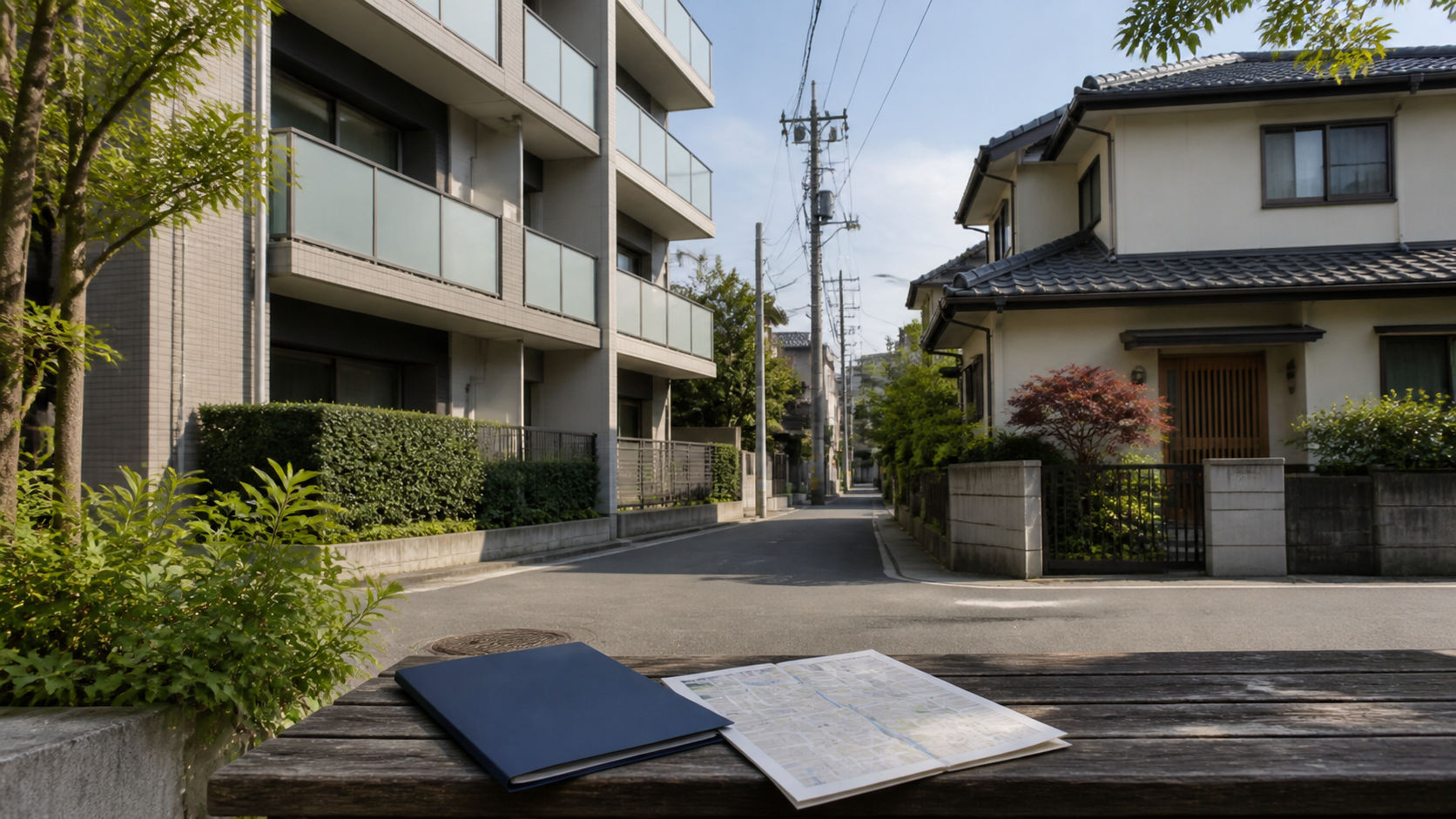
Buying a home in Japan is not one decision. It is a series of connected decisions about where and how you want to live, how long your plans may last, what a particular property requires, and which questions need an official or professional answer.
For many foreign residents, it is useful to separate the subject into a few clear areas: property ownership, residence status, financing, the purchase process, taxes and fees, property condition, location risk, registration, and the responsibilities that continue after handover. These areas can affect one another, but they are not the same system and they do not have one universal answer.
This guide is designed to help you prepare for an ordinary residential home purchase in Japan. It will not tell you whether buying or renting is right for you, predict mortgage approval, calculate your taxes, evaluate a property, or recommend an area. Its purpose is to help you ask better questions before you sign, pay, borrow, or rely on an assumption.
The key distinction
A home purchase can be a long-term life decision. Treat the property, your residence plans, your financing, and the local conditions as separate things to verify.
What this guide covers, and what needs separate advice
This is an orientation guide for ordinary residential homeownership. It covers the decisions and checks that commonly arise when considering a condominium or detached home, whether new or used.
It is not legal, tax, lending, investment, or property-due-diligence advice. A particular transaction can involve documents, deadlines, local rules, and technical issues that this guide cannot decide for you.
Some land and property categories need a separate check rather than ordinary residential guidance. Examples include agricultural land, forest land, commercial property, land in a designated special/security area, and other property subject to a special legal regime. If a listing, broker, local authority, or document identifies a special category, pause and confirm the responsible authority and the applicable process.
Buying or renting: start with the life decision
Buying and renting solve different problems. Neither is automatically the better choice for a foreign resident.
Before looking closely at properties, consider your likely stay horizon, job and household plans, how easily you may need to move, your access to financing, your comfort with maintenance decisions, and how stable the location needs to be for your daily life. Also consider the costs that arrive after the purchase: taxes, insurance, repairs, condominium charges where relevant, utilities, and the possibility that resale timing or price may not match your plans.
Renting can offer flexibility. Buying can mean taking on more control and more responsibility. The useful question is not “Which option is always cheaper?” It is whether the commitments of a particular purchase fit your plans and your ability to manage change.
Before you decide
Before treating a property as your next step, ask: “If my work, household, location or financing situation changes, can I still manage the commitments this home creates?”
Ownership, residence status, and mortgage eligibility are different questions
These three questions are often confused, especially when people search for a simple answer about “foreigners buying property.” They need to be checked separately.
| Question | What it means | What can vary | Who decides or verifies it |
|---|---|---|---|
| Can I own this property? | Ownership and transaction rules for the specific property. | Property category, location, registered rights, special regimes and reporting. | Legal Affairs Bureau, broker, judicial scrivener, responsible authority where needed. |
| Can I live in Japan, and for how long? | Your residence status and immigration position. | Your individual status, period of stay and immigration requirements. | Immigration Services Agency. |
| Can I borrow for it? | A lender’s decision on a loan and its terms. | Lender, product, documents, underwriting and the property. | The selected lender or finance programme. |
Buying a property does not itself create a residence-status, permanent-residence or naturalization route. Those are immigration and nationality matters with their own official criteria.
Similarly, do not treat permanent residence as a one-line nationwide mortgage rule. Some lenders or products may require or strongly prefer particular residence positions; others may use different criteria. Mortgage eligibility, terms, property conditions, and the final underwriting decision are lender- and product-specific.
The safe approach is to avoid building your life plan around an assumption. If residence stability matters to your purchase, verify immigration questions with the Immigration Services Agency and financing questions with the lender before relying on either outcome.
Can a foreign resident buy a home in Japan?
For ordinary residential property, foreign nationality by itself is not a general prohibition on ownership in Japan. However, the property, location, special legal regimes, reporting obligations and financing may still require separate checks.
There is no useful one-sentence nationality slogan that answers every property question. Separate the ownership question from residence status and financing, then check the particular property, its location, its registered rights, and any special regime that may apply.
For many buyers, the practical task is not proving a general label. It is confirming that the property and transaction fit the applicable rules, that all parties understand the transaction, and that the buyer has a realistic route to complete and manage it.
This is also why special land categories should not be treated as ordinary homes. Agricultural land, forest land, and land near certain important facilities can have separate rules or verification routes. A broker or seller should not be your only source for a question that belongs to a responsible public authority or a suitably qualified professional.
Two short checks that can matter in special situations
FEFTA reporting: non-resident is not the same as foreign nationality
Japan’s foreign-exchange rules can require post-acquisition reporting when a person treated as a non-resident under those rules acquires Japanese real property or rights on it within the relevant scope. This is not a rule based simply on citizenship, visa name, or permanent residence.
Where the reporting rule applies, the official guidance says the report is normally made after acquisition, generally within 20 days, through the Bank of Japan route to the Ministry of Finance. The current scope and exceptions matter. If you may be treated as a non-resident, confirm the current Ministry of Finance and Bank of Japan guidance for your own transaction before completion.
Do not assume that every foreign buyer must file a report, or that every non-Japanese resident has the same obligation.
Important Land Act: check the designated area, not a headline
Some designated special monitored areas can have a pre-contract notification process for in-scope transactions involving ownership or rights intended to acquire ownership. This is not a blanket foreign-buyer restriction, and it should not make an ordinary buyer assume that every home is affected.
For a property that may be near an important facility or in another special area, use the official Important Land web map early and confirm the current requirements with the responsible authority. The exact area designation, type of right, property measurement and transaction details matter. Do this before a contract deadline makes the question urgent.
The home-buying process: a guide to the decisions, not a universal script
The order of a transaction can vary with the property, seller, broker, lender, and whether you are buying new or used. Still, the process is easier to manage when you understand the main decision points.
Typical purchase journey
- Define your needs and a realistic planning range. Consider household needs, commute, accessibility, likely stay horizon, and the ongoing commitments you could manage.
- Compare properties and locations. Look beyond photographs and advertised price. Note building type, age, local services, access, likely recurring charges, and visible questions to investigate.
- Speak with the seller or broker. Confirm who represents whom, what information is available, and what further checks are needed.
- Review property information. Ask for relevant records and explanations rather than relying on a listing summary.
- Consider an application or offer where applicable. The form and timing can differ by transaction.
- Check financing in parallel. Do not assume that a preliminary conversation is final approval.
- Receive and review the important-matters explanation. Ask questions before signing, especially where a term, restriction, charge, document, or future responsibility is unclear.
- Check condition and building evidence. Inspection, evaluation, maintenance and renovation information are property-specific; decide which evidence you need.
- Sign only after unresolved questions have a responsible answer. A contract is not the moment to discover the most important unknowns.
- Complete financing and settlement arrangements. Exact documents and timing vary.
- Register the ownership transfer. Registration is an important completion step for registered property/right information.
- Receive handover and keep key records. Retain contracts, disclosure documents, tax and payment records, manuals and management documents.
- Manage continuing obligations. Taxes, insurance, repairs, condominium charges and local procedures can continue after the purchase.
Some steps are legally required in a covered transaction; others are common practice or depend on the property. Your broker can explain the transaction process, but a common process should never be mistaken for a complete risk assessment.
Choose the property type by the questions it creates
Condominium and detached home
| Consideration | Condominium | Detached home |
|---|---|---|
| Shared elements | Common areas and building systems are managed collectively. | Responsibilities are often more directly tied to the individual property. |
| Ongoing charges | Management fees and repair reserves may apply. | Maintenance planning and costs may be more directly managed by the owner. |
| Documents to review | Management association, fees, reserve, repair plan, rules and building information. | Land, building, boundary/access, maintenance and site-specific information. |
| Key caution | A reserve or plan is not proof that all future work is funded. | A detached home still needs property, location, condition and local-rule checks. |
For a condominium, ask for the management information that helps you understand how the building is run: current management fees, repair reserve, long-term repair plan, planned major work, relevant rules, and the condition of the management structure. Japan’s condominium legal framework changed in 2026, but that reform does not tell you whether a particular building is well managed, sufficiently funded, or suitable for your needs. Those are building-level questions.
New and used homes
New and used are not quality rankings. A used home can require careful review of condition, maintenance, renovation history, performance information, and inspection scope. A new home can still require you to understand the documents, location, management structure, warranties and ongoing commitments.
An existing-home inspection can provide useful evidence, but it has a defined scope. Confirm what was inspected, what was not inspected, the inspection date, findings, limitations and any recommended next step. A performance label or evaluation can also help, but neither replaces a property-specific review.
Mortgage and financing orientation
A mortgage is a product decision by a lender, not a consequence of wanting to buy a home. The lender may assess your documents, employment/income information, residence position, repayment plan, property, loan term, insurance or guarantee requirements, and other product conditions. Public finance programmes can have their own technical and eligibility rules.
Before you rely on financing, ask the selected lender what it needs from you, what is only a preliminary assessment, and what could still change before final approval. If you are comparing products, compare their current official terms rather than relying on forum discussions or old summaries.
Avoid two opposite mistakes: assuming that permanent residence automatically solves mortgage questions, or assuming that non-PR status gives a universal answer. Neither is a safe nationwide conclusion.
Costs: map the categories before you calculate the total
The advertised purchase price is only one category. Costs and taxes depend on the transaction, property, financing, location, legal status and services involved. There is no reliable universal “closing cost percentage” for this guide to give you.
Costs to plan for
| Timing | Categories to identify | What to verify |
|---|---|---|
| Before / at contract | Purchase price, deposit or earnest money, brokerage remuneration where applicable, stamp-related costs. | Amount, payment timing, refund/forfeit conditions, tax treatment. |
| Completion | Registration-related tax/fees, professional costs where applicable, lender costs, insurance. | Which costs apply, who receives them, and the current eligibility/relief conditions. |
| After acquisition | Real-property acquisition tax, fixed-asset tax, city-planning tax where applicable, utilities, insurance, maintenance. | Competent authority, property/location basis, billing timing. |
| Ongoing homeownership | Condominium management fees and repair reserves, repairs, renovation, moving and household costs. | Building documents, actual service arrangements and your maintenance responsibility. |
Registration and licence tax is a national tax. Real-property acquisition tax is a prefectural tax. Fixed-asset tax and city-planning tax are local taxes. Some housing tax measures are conditional and temporary, so do not make a purchase decision from an old rate table or a general online estimate. Confirm the relevant tax authority and current rules for the particular purchase.
What to check before signing
Before you sign
Use this list to identify questions that need an answer before you make a commitment:
- What registered ownership and rights information is relevant to the property?
- What does the important-matters explanation say, and which statements need a clearer source or explanation?
- What is known about physical condition, building age, maintenance, renovations, inspection and performance evidence?
- For a condominium, what do the management, reserve and long-term repair documents show?
- What are the current and expected ongoing fees or responsibilities?
- What local planning, zoning, road/access or land-use questions need official confirmation?
- What do the national and municipal hazard tools show for the exact location?
- Is the property in a special area or category requiring a separate authority check?
- Which financing, tax, registration or contract questions are still assumptions rather than confirmed answers?
Important-matters explanation: important, but not a complete guarantee
An important-matters explanation is an important legally required disclosure step in covered real-estate transactions. Read it before you sign, ask for clarification where needed, and keep a copy.
It is not proof that every physical condition, boundary, future maintenance, hazard, planning, local tax, or future-use question has been independently resolved. Use it as one major source of information and identify what needs a separate local, technical, official, or professional check.
Registration: a key record with clear limits
Real-property registration records the registered description of the property and the rights associated with it. Ownership-transfer registration is an important part of completion, and the Legal Affairs Bureau and a judicial scrivener may be relevant depending on the transaction.
Registration records are not a certificate that the building is physically sound, that boundaries are undisputed, that hazards are absent, that every planning issue is resolved, or that the property has no problems. Treat them as one part of a wider verification set.
Hazard, location and building-age checks
Location conditions can shape daily life and long-term responsibilities. Start with a national hazard discovery tool, then check the municipality’s authoritative maps and information for the exact address. Depending on location, that may include flood, landslide, tsunami, earthquake-related, liquefaction, evacuation, drainage, road or other local context.
Hazard maps help you ask the right questions. They do not create an AIC safety score, guarantee that an area is safe, or replace property-specific professional and local verification.
The same caution applies to building age. A date, including a post-1981 construction date, is one piece of context and not a conclusion that a building is “earthquake-safe” or problem-free. Actual condition, applicable standards, modifications, maintenance records, inspection and performance evidence can all matter.
After you buy: ownership continues
After handover, keep your transaction and property records organised. You may need them for tax, insurance, maintenance, financing, renovation, management, or future sale questions.
Expect continuing responsibilities. They can include local tax obligations, maintenance, insurance, utility arrangements, and, for a condominium, management fees, repair reserves, building rules and major-repair decisions. Use the relevant AIC guides for practical topics such as utilities, local procedures and tax orientation, but confirm an official authority or qualified professional where an answer depends on your property or personal circumstances.
Before you pay or sign: common red flags
- Assuming that a mortgage discussion equals final approval.
- Treating property ownership as a visa, PR or naturalization route.
- Paying before you understand the contract, payment conditions and what remains unresolved.
- Looking only at the advertised price and not the continuing costs.
- Ignoring condominium fees, repair reserves, management documents or planned work.
- Treating a broker’s disclosure as a complete substitute for every local, physical or technical check.
- Ignoring location hazards, land-use questions, road/access issues or special-area status.
- Assuming a registry record proves that a property is problem-free.
- Assuming a building-age rule guarantees safety.
These are preparation risks, not accusations of wrongdoing. A calm, documented question before contract can be more useful than a rushed answer afterward.
Who to verify with
| Your question | Usual verification route | Keep in mind |
|---|---|---|
| Registered ownership/right information | Legal Affairs Bureau; judicial scrivener where needed | Registration is important but has limits. |
| Transaction documents / important-matters explanation | Licensed real estate transaction agent (宅地建物取引士) | Ask what a statement covers and what it does not. |
| Mortgage eligibility / product terms | Selected lender or relevant finance programme | Provider-specific; final underwriting can vary. |
| National tax question | National Tax Agency where responsible | Do not treat NTA as the authority for every local tax. |
| Acquisition / fixed-asset / city-planning tax | Competent prefecture or municipality | Local and property-specific rules matter. |
| Hazards, planning and local conditions | Municipality, prefecture, official hazard systems | Check the precise property/location. |
| Physical condition / boundaries / building evidence | Appropriate qualified building professional or inspector | Scope and need depend on the property. |
| FEFTA or special-area rules | Ministry of Finance/Bank of Japan route or responsible official authority | Confirm current scope before relying on an assumption. |
Not every purchase needs every professional. The point is to match the question to the authority or expertise that can answer it.
Related AIC guides
When you need practical preparation around a home purchase, these AIC topics can help you organise the next question:
- Renting in Japan: for comparing the commitments of renting and buying.
- Long-Term Life in Japan: for wider life-planning and administration orientation.
- Tax in Japan: for general tax orientation before seeking the responsible authority.
- City/Ward Office Setup: for local administration context.
- Utilities in Japan: for post-move practical preparation.
- Visa & Residence: for residence-status orientation.
- Official Resources: for direct official authority routes.
Official sources to start with
- Ministry of Finance: real-property reporting by non-residents
- Cabinet Office: Important Land Act notification guidance
- Ministry of Land, Infrastructure, Transport and Tourism: consumer real-estate transaction guidance
- Ministry of Justice: real-property registration
- MLIT Disaster Prevention Portal
- Immigration Services Agency
- National Tax Agency
Before you act
Buying a home in Japan can be approached step by step. Start with your life plans, then confirm the property, the location, the financing, the documents and the continuing obligations. Do not rush because a property is attractive, a lender conversation sounds promising, or an online claim gives a simple answer.
AIC can help you prepare and understand the questions. Official authorities, lenders and suitably qualified professionals make the decisions and give the property-specific answers. Before signing, paying, borrowing, or relying on a tax or eligibility assumption, verify the current rule and the exact facts of your case.
Leave a Reply